Every South Florida homeowner knows the drill. A named storm forms in the Atlantic, the forecast cones start showing up on the news, and the question in the back of everyone’s mind is the same: what happens when the power goes out? In Miami, an outage is not a rare event. Between hurricane season, summer thunderstorms, and an aging grid under heavy load, losing power for hours (or days) is simply part of life here. For a high-end home full of climate control, refrigeration, security systems, and smart technology, that is more than an inconvenience. It is a real risk to comfort, safety, and property. A whole-home battery backup system is the modern answer. It keeps your home running quietly and automatically when the grid fails, with no fuel, no noise, and no fumes. Here is how it works, how it compares to a generator, and what you need to know before installing one in Miami.
Why South Florida homes need backup power more than most
Florida is one of the states hit hardest by weather-related power outages, and Miami-Dade sits right in the path of the storms that cause them. Even a Category 1 hurricane can knock out power to hundreds of thousands of homes, and full restoration often takes days. Add in the daily summer storms that roll through between June and October, and the reality is clear: the grid here goes down more often than in almost any other major U.S. metro. For a luxury property, the stakes are higher. A prolonged outage means no air conditioning in 90-degree heat and high humidity, spoiled food in the refrigerator and wine cellar, security cameras and gates offline, and pool pumps sitting idle. Backup power is no longer a luxury add-on. For many high-end homeowners in North Miami, Bay Harbor, and the surrounding areas, it has become essential.
Battery backup vs. standby generator
The two main ways to keep your home powered during an outage are a battery backup system and a standby generator. Both have their place, and the right choice depends on your priorities. A standby generator runs on natural gas or propane and can power a large home for many days, as long as fuel keeps flowing. It is the traditional choice for long outages. The trade-offs are noise, regular maintenance, fuel dependence, and exhaust that has to be safely vented away from the home. A whole-home battery backup system stores electricity and delivers it instantly and silently the moment the grid goes down. There is no fuel to store, no engine to service, and nothing to hear. Batteries are also far better suited to short and frequent outages, which are the most common kind in Miami. They also pair naturally with solar. The main limitation is runtime: a battery holds a fixed amount of energy, so for very long multi-day outages you either size up with multiple units or pair it with solar panels that recharge the battery each day. For many Miami homes, the ideal setup is actually a combination: solar panels to generate power, a battery to store it and deliver clean instant backup, and in some cases a generator as a long-duration safety net.
What a whole-home battery system actually powers
How much of your home a battery can run depends on its capacity and how the system is designed. A single battery unit can comfortably cover the essentials: refrigerator, lights, internet, security system, and a few outlets. Add more capacity and you can keep central air conditioning, pool equipment, and even a home office or media room running through an outage. During installation, an experienced electrician works with you to identify your critical loads and design the system around them. In a well-planned setup, the transition is seamless. When the grid drops, the battery takes over in a fraction of a second, and most of the time you will not even notice the switch.
Pairing battery backup with solar
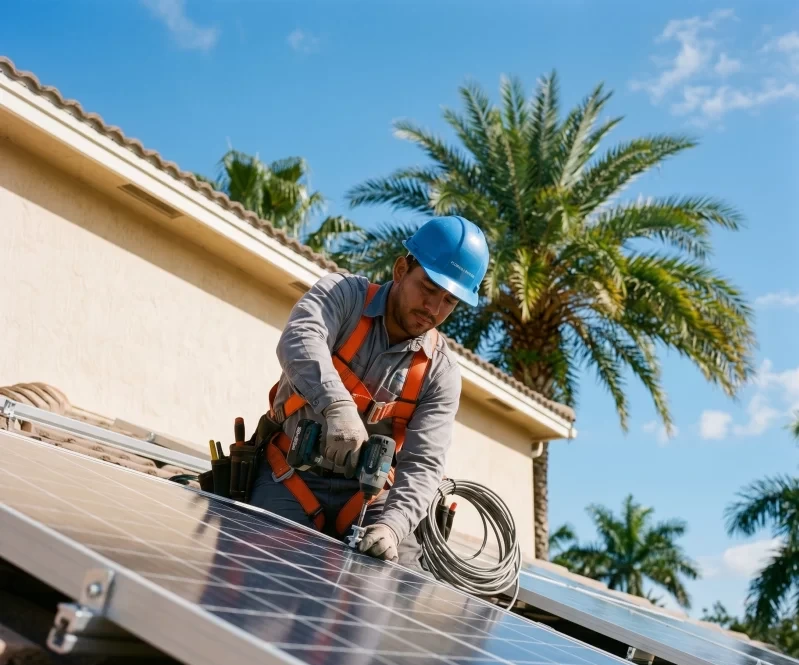
In Florida’s sunshine, solar and battery storage are a natural fit. Solar panels generate power during the day, the battery stores what you do not use, and that stored energy is available at night or during an outage. When a storm knocks out the grid for several days, a solar-plus-battery system can recharge itself each day, effectively giving you unlimited runtime as long as the sun comes up. With FPL having approved the largest rate increase in its history for 2026, this pairing also does something a generator never will: it lowers your everyday electric bill, not just your storm season stress. The system pays for itself a little more with every billing cycle.
What Miami homeowners need to know before installing
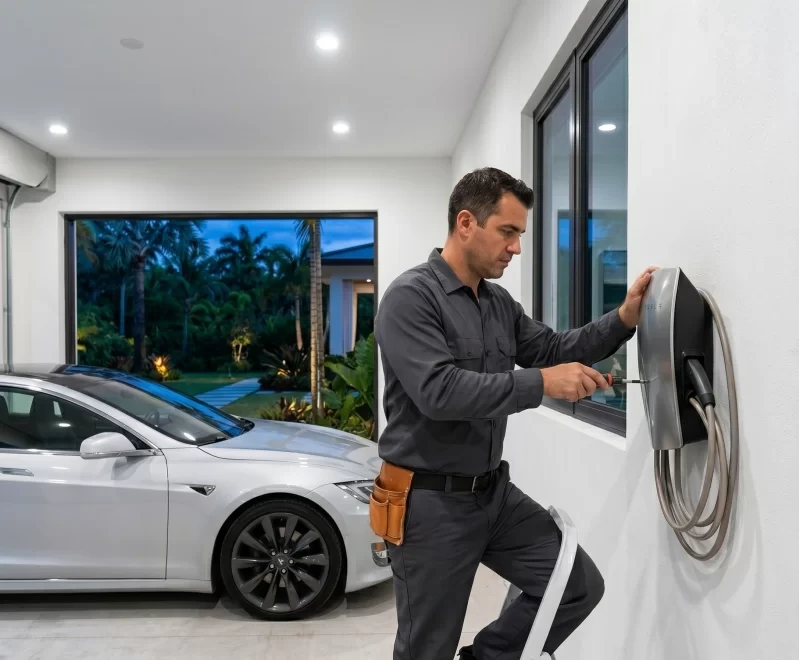
Installing backup power in South Florida is not a plug-and-play project, and a few local factors make professional installation essential. Permits and inspections are required. Miami-Dade County has some of the strictest building and electrical codes in the country, and any backup power system must be permitted, installed to code, and inspected. Equipment also has to meet wind-load and hurricane standards, which matters for anything mounted outdoors. Salt air is another consideration. Homes near the coast face constant exposure to corrosive salt air, so equipment placement, enclosures, and connections all have to be chosen with that in mind to protect your investment for the long term. Finally, if you are connecting to solar or to the FPL grid, the system needs a proper interconnection agreement and the right transfer equipment so that power flows safely and never back-feeds onto lines where a utility worker could be. This is exactly the kind of work that should only be handled by an experienced, insured electrician.
What does a whole-home battery backup cost in Miami?
Pricing varies with the size of your home and how much you want to keep running, but as a general guide, a quality battery backup installation in the Miami area typically starts with a single battery covering essential circuits and scales up from there for larger homes or full whole-home coverage. Pairing with solar increases the upfront investment, but it adds daily energy savings that neither a standalone battery nor a generator can match, which matters more than ever with FPL rates rising sharply in 2026. The most accurate way to know your number is a site visit, where an electrician can assess your electrical panel, your critical loads, and the best placement for the equipment. Every high-end home is different, and the design should be tailored to it.
Protect your home before the next storm
Hurricane season runs through the end of November, and the best time to plan a backup power system is before a storm is on the radar, not during the rush when everyone else is scrambling. A properly designed and professionally installed battery backup system gives you something valuable: the confidence that your home, your family, and your investment stay protected no matter what the grid does. At B-GELEC, we design and install whole-home battery backup, solar, and standby power systems for high-end residential properties across North Miami and South Florida. Every installation is handled by an experienced, insured professional and built to Miami-Dade code. If you would like to talk through the right backup solution for your home, request your free quote through our contact form and we will put together a plan tailored to your property. B-GELEC High-End Residential Electrician, North Miami & South Florida Phone: (954) 501-4172 Email: contact@b-gelec.us Web: www.b-gelec.us